
Indian Customs & Traditions
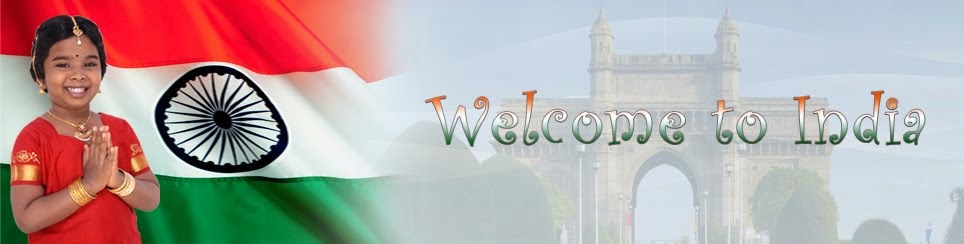
 NAMASKAR : While doing namaste is the most popular form of greeting in India. It is a general salutation that is used to welcome somebody and also for bidding farewell.While doing namaskar, both the palms are placed together and raised below the face to greet a person.
It is believed that both the hands symbolise one mind, or the self-meeting the self. While the right hand represents higher nature, the left hand denotes worldly or lower nature.
Other common forms of greetings by various communities and regions in India are-Sat-Sri-akal by the Sikhs. Adaab by the Muslims, Vannakkam by Tamilians, July by the Ladhakis and Taisho Deluge by the Sikkimese, amongst other.
TILAK : Tilak is a ritual mark on the forehead. It can be put in many forms as a sign of blessing, greetings or suspiciousness.
The Tilak is usually made out of a red vermilion paste (kumkum) which is a mixture of turmeric alum, Iodine, Camphor, etc. It can also be of sandalwood paste (chandan) blended with musk.
The tilak is applied on the spot between the brows which considered the seat of latent wisdom and mental concentration, and is very important for worship. This is the spot on which yogis meditate to became one with Lord Brahma. It also indicates the point at which the spiritual eye opens. All thoughts and actions are said to be governed by this sport. Putting of the coloured mark symbolizes the quest for the 'opening' of the third eye.
All rites and ceremonies of the Hindu begins with a tilak opped with a few grains of rice placed on this spot with the index finger or the thumb. The same custom is followed while welcoming or bidding farewell to guests or relations.
AARTI : 
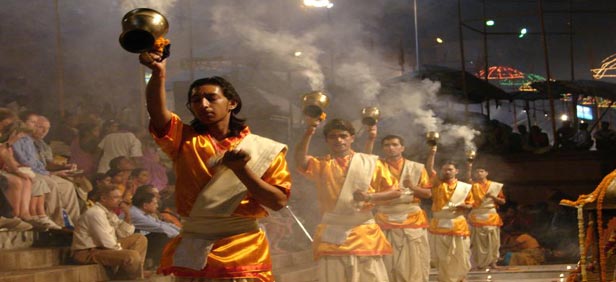
Is penormed as an act or veneration and love. It is often performed as a mark of worship and to seek blessing from god, to welcome the guests for children on their birthday, family members on auspicious occasions or to welcome a newly wedded couple.
For performing Aarti, five small lamps called nirnanas are filled with ghee or oil and arranged in a small tray made of metal. A wick is made out of cotton, wool and placed in the lamps. A conch shell filled with water, auspicious leaves or flowers, incense or lighted camphor are also placed in the tray is roured in a circular motion in front of the deity or the person to be welcomed.
The purpose of performing arati is to ward off evil effects and the malefic influences of he 'evil eye'.
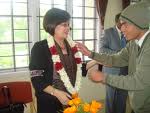
GARLANDING : Flower garlands are generally offered and honour. They are offered to welcome the visitors or in honour to the Gods and Goddesses.
The garlands are generally made with white jasmine and orange marigold flowers. They are weaved in thread tied in the end with a help of knot.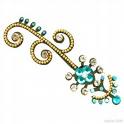
BINDI : A bindi is an auspicious mark worn by young girls and woman. Bindi is derived from Bindu, the Sanskrit word for dot. It is usually a red dot made with vermilion powder which is worn by women between their eyebrows on their forehead.
Considered a symbol of Goddess Parvati, a bindi signifies female energy and is believed to protect women and their husbands. Traditionally a symbol of marriage, it has also become decorative and is worn today by unmarried girls and women as well.
No longer restricted in colour or shape, bindis are seen in many bright colours and in different shapes and designs. They are also made of coloured felt and embellished with coloured glass or glitter.
ESSENTIAL ORNAMENTS :
Nose Pin »  Many Indian women wear a pin on their nose studded with stones, called a nose pin is today adorned by many unmarried girls as well.
Mangalsutra » Is a necklace made of black beads, worn only by the married women as mark of being married. It is the Indian equivalent of the western wedding rings.
The mangalsutra is tied by the groom around his bride's neck.
Mangalsutra is generally made out of two strings of small black beads with gold pendant. The black beads are believed to act as protection against EVIL. The married woman wear this to protect their marriage and the life of their husband.
In southern India, the mangalsutra is called 'tali'. It is a small gold ornament, stung on a cotton cord or a gold chain.
Shakha - Paula » Are a pair of shell (shakha) and red coral (paula) bangles worn as marriage symbols by the Bengali women.
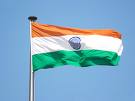
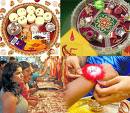
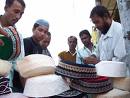
INDEPENDENCE DAY RAKHI PURNIMA ID-FESTIVAL
GOOD FRIDAY